As pregnancy progresses, the focus often shifts.
Early on, it’s about staying active, managing symptoms, and adapting to a changing body. But as you move closer to delivery, a more specific question starts to come up:
How do I actually prepare my body for labor and delivery in a way that feels useful and practical?
For many, this is where things become unclear. There’s no shortage of advice—walk more, stretch more, do kegels—but very little explanation of what actually matters and why.
The truth is, labor is not separate from how you’ve been moving and using your body throughout pregnancy.
It is a continuation of it.
Labor Is a Physical and Coordinated Event
Labor is often framed as something that happens to you.
But in reality, it is something your body actively does.
It requires:
- Endurance over time
- Coordination between muscles and breath
- The ability to generate and manage pressure
- The ability to shift between tension and relaxation
This is why many describe labor as feeling physical in a way they didn’t expect. Not because something is wrong—but because it is a full-body effort.
When you begin to view labor this way, preparation starts to make more sense.
You’re not just “getting ready”—you’re building the capacity to respond.
Building Strength for Labor and Delivery
Strength during pregnancy isn’t about pushing limits or chasing numbers.
It’s about creating support, efficiency, and resilience—so your body can handle the sustained effort of labor.
Key Areas to Focus On
There are a few areas that consistently play a larger role:
- Hips and glutes support pelvic positioning and contribute to force generation during pushing
- Core muscles assist with pressure management and coordination with breath
- Pelvic floor needs to both support and release at the right times
- Upper body helps maintain positions and reduces fatigue during longer labors
But strength is not just about what you train—it’s about how those areas work together.
During labor, your body isn’t isolating muscles. It’s coordinating systems under load, often while fatigued. Preparing for that means practicing movements that build awareness, control, and endurance—not just isolated strength.
This is why the conversation around “best exercises for labor” can be misleading—because preparation is less about specific exercises and more about how your body learns to work together.
Mobility: Allowing the Body to Adapt
Strength provides support, but mobility allows the body to respond.
The pelvis is not a fixed structure. It subtly adjusts based on:
- Position
- Muscle tension
- The movement of the baby
If mobility is limited, the body has fewer options to adapt. If mobility is available, positioning becomes more intuitive and often more comfortable.
What This Looks Like in Practice
Instead of thinking about “stretching more,” think about:
- Moving the hips in multiple directions
- Exploring gentle weight shifts
- Practicing supported positions like squats or kneeling
Simple movements like:
- Rocking
- Circling the hips
- Shifting side to side
…can go a long way in helping the body feel more adaptable.
The goal is not complexity—it’s familiarity.
Breathing During Labor: The Bridge Between Effort and Control
Breathing is one of the most powerful tools during labor—but it’s often misunderstood.
When people ask, “How should I breathe during labor?” they’re usually expecting a single technique.
But breathing is not one strategy—it’s something that evolves throughout labor.
Understanding how to use breathing during labor can make a significant difference in how you manage both discomfort and effort.
Early Labor: Reducing Tension
In the early stages, slower, controlled breathing helps:
- Reduce unnecessary tension
- Improve oxygen flow
- Keep the nervous system more regulated
This is where many people benefit from learning how to not hold their breath when discomfort increases.
Active Labor: Matching Intensity
As contractions become stronger, breathing often becomes more rhythmic and responsive.
The goal is not to stay perfectly calm—it’s to:
- Stay connected
- Avoid breath-holding
- Allow the body to work
Pushing Phase: Coordinating Effort
During pushing, breathing shifts again.
More forceful exhalation helps:
- Generate pressure
- Coordinate effort with contractions
- Support the natural progression of delivery
Why Practice Matters
Under stress, the body defaults to habit.
If breath-holding or shallow breathing is your default, it will show up during labor.
Practicing breathing patterns during pregnancy makes them more accessible when intensity rises.
Pressure Management and the Pelvic Floor
One of the most important—and often overlooked—parts of preparing for labor is understanding pressure.
Your body is constantly managing pressure through the coordination of:
- The diaphragm
- The core
- The pelvic floor
This is exactly where working with a pelvic health physical therapist can be valuable, helping you learn how to coordinate strength and relaxation in a way that actually translates to labor and delivery.
The Role of the Pelvic Floor
The pelvic floor is not just a “muscle to strengthen.”
It needs to:
- Support pressure during pregnancy
- Respond to changing demands during labor
- Relax and lengthen during delivery
This is where many people get mixed messages.
A Common Misconception
Preparation is often reduced to:
“Do more kegels.”
But a pelvic floor that is always contracting can become just as limiting as one that is weak.
Effective preparation means learning:
- When to engage
- When to relax
- How to coordinate with breath
That coordination is what supports effective pushing and delivery—not strength alone.
Preparing the pelvic floor, then, is less about doing more strengthening and more about understanding how it responds to pressure, movement, and breath.
Movement During Labor: Adaptability Over Memorization
Labor is not meant to happen in a single position.
And yet, many people feel like they need to “know the right positions” ahead of time.
The goal is not memorization.
It’s adaptability.
This is often something that’s practiced and refined in physical therapy—learning how to move with awareness so your body has options when it matters most.
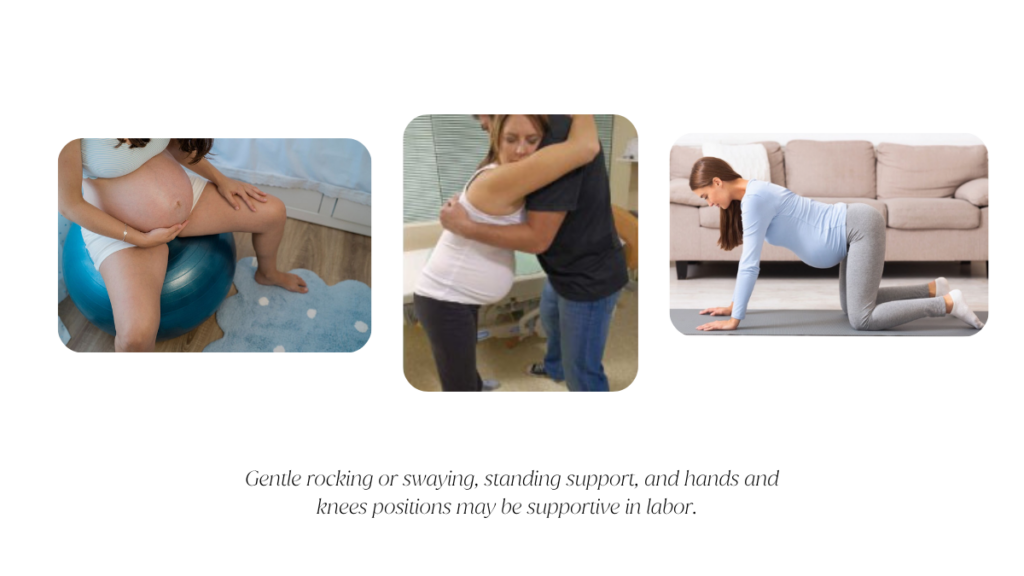
Positions to Become Familiar With
- Supported squats
- Hands-and-knees positions
- Side-lying positions
- Standing with support
- Gentle rocking or swaying
These positions can:
- Improve comfort
- Support baby positioning
- Help labor progress
But more importantly, they give your body options.
When your body is familiar with these movements, you’re more likely to:
- Change positions intuitively
- Respond to what feels right
- Stay more comfortable throughout the process
Comfort Measures: Practical Tools That Make a Difference
Preparation is not just physical—it’s also practical.
Knowing how to manage discomfort during labor can change the entire experience.
Common Comfort Strategies
- Counterpressure on the hips or low back
- Gentle soft tissue work
- Movement during contractions
- Coordinating breath with effort
These are not complex techniques, but they are effective.
Practicing them ahead of time helps them feel more natural, especially when intensity increases.
The Role of a Support Team
Labor is not something you have to navigate alone.
The people around you play a significant role in how supported and confident you feel.
A strong support team may include:
- A partner or spouse
- A physical therapist
- A doula
- Your medical provider
Why Support Matters
Support is not just emotional—it’s practical.
Having someone who can:
- Guide positioning
- Offer reassurance
- Help you stay focused
…can make a meaningful difference in both the experience and outcomes.
Doulas, in particular, provide continuous support throughout labor. Their role often bridges the gap between physical preparation and real-time guidance, helping individuals and their partners feel more confident in the moment.
Having the right guidance ahead of time—whether through education, movement practice, or hands-on care—can make these tools feel much more accessible during labor.
Preparing for Recovery Starts Now
Preparation for labor is also preparation for what comes after.
The same qualities that support labor:
- Strength
- Coordination
- Pressure management
- Body awareness
…also support postpartum recovery.
When these systems are working well, many people find:
- Smoother recovery
- Better pelvic floor function
- Easier return to activity
RECOVERY ISN’T ONE-SIZE-FITS-ALL
How you recover depends on how you delivered.
After a vaginal delivery, the pelvic floor and perineal tissue need time to regain coordination before they’re ready for more load. After a cesarean delivery, the incision becomes the focus—scar tissue can restrict movement of the abdominal wall long after the surface has healed, limiting things like rotation, bending, or core engagement without you realizing why.
Either way, recovery works better as a progression than a deadline.
CORE SEPARATION IS NORMAL—FUNCTION IS WHAT MATTERS
Some abdominal separation, often called diastasis recti, happens in nearly every pregnancy. It’s not a sign that something went wrong.
What matters more than the separation itself is whether the core can still manage pressure across it. This is where adaptive, awareness-driven strength comes in—learning to load the core based on what it can actually do right now, not a routine borrowed from before pregnancy.
PREPARED TISSUE RECOVERS DIFFERENTLY
The same idea applies to the perineum. Practicing perineal massage in the final weeks of pregnancy can improve tissue pliability going into delivery—and tissue that’s been prepared for stretch often has an easier time healing afterward.
A POSTPARTUM EVALUATION
A postpartum physical therapy evaluation, ideally in the first several weeks after delivery, can assess pelvic floor strength and coordination, abdominal wall function, and overall movement patterns before returning to more demanding activity.
WHEN TO REACH OUT
A few things are worth attention rather than waiting out:
Leaking with coughing, sneezing, or exercise
A sensation of heaviness or bulging in the pelvis
Ongoing doming through the midline of the abdomen
Pain that isn’t continuing to improve
If any of these sound familiar, reaching out sooner tends to make more of a difference than waiting.
A More Complete Approach to Labor Preparation
When people search for:
- “How to prepare for labor naturally”
- “Best exercises for pregnancy”
- “How to make labor easier”
They’re often looking for a single answer.
But preparation isn’t one thing.
It’s the combination of:
- Strength
- Mobility
- Breathing
- Awareness
- Support
And perhaps most importantly—trust in your body’s ability to respond.
The Bottom Line
Preparing your body for labor and delivery is not about controlling the experience.
It’s about building the capacity to move through it.
When you develop:
- Strength to support effort
- Mobility to allow adaptation
- Breath control to manage pressure
- Awareness to guide decisions
You create a foundation that allows you to meet labor with more confidence.
Every birth experience is different.
But preparation gives you something consistent:
The ability to respond—rather than react—when it matters most.
If you’re thinking about how to better prepare your body for labor and delivery, having guidance can make this process more clear and less overwhelming. Working one-on-one allows you to build strength, improve mobility, and understand how your body responds—so you can go into labor feeling more prepared.
FAQ: Preparing Your Body for Labor and Delivery
The most effective approach combines strength training, mobility work, breathing practice, and movement awareness. Together, these help improve endurance, coordination, and confidence during labor.
Exercises for labor like squats, hip mobility drills, core coordination work, and pelvic floor training (both activation and relaxation) help prepare the body for labor.
Breathing is essential. It helps reduce tension, improve oxygen flow, manage discomfort, and support effective pushing during delivery.
Both. The pelvic floor needs strength to support the body and the ability to relax during delivery. Coordination between the two is key.
Yes. Movement can improve comfort, support baby positioning, and help labor progress more efficiently.
You can begin early in pregnancy, but the second and third trimesters are especially important for building strength, mobility, and breathing awareness.


