
You strain your hamstring.
At first, it’s obvious. Pain with walking. Tightness. Maybe even a sharp pull.
So you rest. Stretch a bit. Take some time off.
A few weeks later?
It feels better. Maybe even normal.
So you go back to running, lifting, or your sport…
…and it comes right back.
This cycle is incredibly common with hamstring injuries—and it’s not bad luck.
It’s a misunderstanding of what recovery actually means.
Because for most people, recovery ends when pain disappears.
But pain disappearing is not the same as your body being ready.
If you’re dealing with a hamstring injury—or any injury that keeps coming back—working with a practitioner who understands this full process can make all the difference.
Why Hamstring Injuries Are So Common—and So Stubborn
Hamstring strains show up most in environments that demand speed and force:
- Sprinting
- Rapid acceleration and deceleration
- Explosive changes in direction
That’s why we see them so often in soccer, track and field, football, and other field and court sports.
But the sport itself isn’t the real issue.
The real issue is this:
The hamstring is asked to handle high force while lengthening at speed
And if that capacity isn’t rebuilt during rehab, the body simply isn’t prepared to go back.
The Three Phases of True Recovery
Most people think recovery is something that just… happens with time.
You rest, things calm down, and eventually you get back to what you were doing.
But if you’ve ever dealt with a hamstring strain that keeps coming back, you’ve already experienced the truth:
Time alone doesn’t restore capacity.
Recovery moves through stages—and each one asks something different of your body.
Early On, It’s About Staying Connected—Not Just “Resting”
Right after an injury, everything feels loud.
Pain, tightness, hesitation. The body is protective—and for good reason.
This is where most people either do too much… or nothing at all.
But neither is actually helpful.
If you completely shut things down, the body adapts quickly:
- It avoids using the injured area
- Other muscles take over
- Movement patterns begin to shift
And while pain may decrease, the system becomes less coordinated.
So instead of asking:
“How do I rest this?”
A better question is:
“How do I stay connected to this without aggravating it?”
That might look like small, controlled movements.
Light activation. Positions that feel safe but still engaged.
It won’t feel like much—but this is where you prevent the disconnect that makes recovery harder later.
Then Comes the Phase Where You Feel Better—But Aren’t Done
This is where most people unintentionally stop.
Pain has settled. Walking feels normal. Maybe you’ve even returned to some workouts.
And it feels like you’re back.
But underneath that, something important is still missing.
The body has regained access to movement—but it hasn’t rebuilt capacity within that movement.
This is where we shift from:
“Can I do it?”
to
“How well can I handle it?”
Now we start loading the system again—but with intention. This is where guided progression matters—especially when rebuilding strength in a way that actually carries over to real life.
Not just stretching or light strengthening, but movements that reflect how the hamstring actually works:
- Accepting load as it lengthens
- Coordinating with the hips and trunk
- Controlling force—not just producing it
You might notice:
- One side working harder than the other
- Subtle shifts or compensations
- Movements that feel “off,” even if they don’t hurt
That’s not a problem—it’s information.
Because this phase isn’t just about getting stronger.
It’s about rebuilding trust in the system.
And Finally—The Phase That Determines If It Comes Back
By this point, most people feel fine.
No pain. Full movement. Back to normal routines.
And this is where recovery quietly ends for a lot of people.
But this is also where it actually needs to begin.
Because the environment where you got injured likely included:
- Speed
- Fatigue
- Quick transitions
- High force while lengthening
And none of that has been tested yet.
So we begin to reintroduce it—gradually and intentionally.
Not in a reckless way, but in a way that teaches the body:
“You can handle this again.”
That might look like:
- Moving faster
- Changing direction
- Absorbing force
- Building toward sprinting or explosive effort
And what matters most here isn’t just strength—it’s timing.
Does the hamstring engage when it needs to?
Can it absorb force without tightening defensively?
Can it repeat effort without breaking down?
This is where the body moves from:
“I can exercise”
to
“I can handle real life again.”
What This Reveals About Recovery (Beyond Just Hamstrings)
While we’re using a hamstring strain as the example, this pattern applies to every injury.
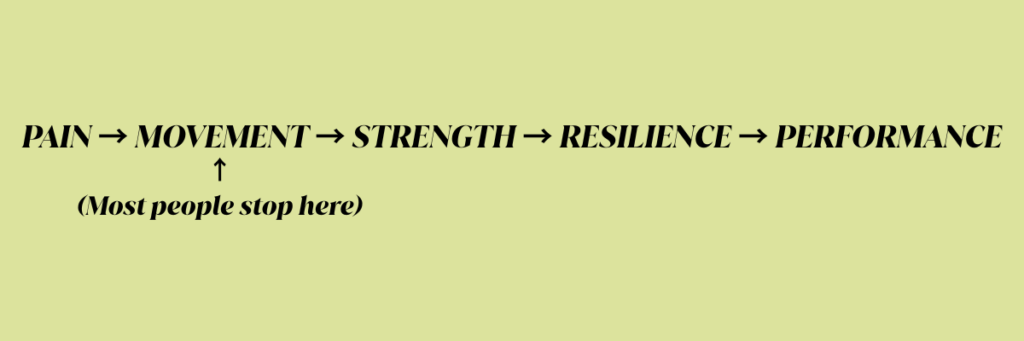
Recovery always follows the same arc:
- Restore movement
- Rebuild strength
- Develop resilience
Where people get stuck isn’t in the injury—it’s in ending the process too early.
The body doesn’t just need healing.
It needs:
- Exposure
- Adaptation
- Progression
That’s true whether it’s a shoulder, knee, back, or something that “almost goes away” but never fully resolves.
The location changes.
The principle doesn’t.
“Pain disappearing is not the same as your body being ready.”
Hamstring Recovery Timeline: Where Most People Think They Are vs. What’s Actually Happening
One of the most common questions is:
“How long does it take to recover from a hamstring strain?”
But a better question is:
“What has my body actually rebuilt so far?”
Because recovery doesn’t follow a clean timeline—it follows progression.
Still, here’s what most people experience:
Weeks 1–2: Pain Is the Loudest Signal
Movement is limited. The body is protective.
This aligns with the early phase—but even here, the goal isn’t to shut things down.
It’s to stay gently connected.
Weeks 2–4: The False Finish Line
This is where most people feel dramatically better.
And it creates a dangerous assumption:
“I’m healed.”
But underneath:
- Strength hasn’t been rebuilt
- Load tolerance is still low
- Coordination is still adapting
This is where many people return too soon.
Weeks 4–8: Where Real Progress Happens
Now the body begins to actually rebuild:
- Strength improves
- Movement feels more natural
- Capacity starts to return
This is where recovery becomes real—not just symptom relief.
Weeks 6–10+: The Phase Most People Skip
This is where re-injury is decided.
Running returns—but not sprinting.
Exercise returns—but not full demand.
And that gap?
That’s where problems come back.
Because this is where the body has to prove:
It can handle real life—not just controlled movement.
Important Perspective
Timelines don’t heal injuries—progressions do.
Two people at the same week post-injury can be in completely different places depending on what they’ve actually rebuilt.
Recovery isn’t about time.
It’s about capacity.
The Real Reason Hamstring Injuries Keep Coming Back
It’s rarely because the injury was severe.
It’s because recovery stopped here:
- Pain went away
- Movement returned
- Activity resumed
But resilience was never built.
So when the body is asked to sprint, decelerate, or absorb force again—it isn’t ready.
And the hamstring becomes the place that reveals it.
The Bottom Line: Recovery Isn’t a Moment—It’s a Standard
Recovery isn’t defined by the absence of pain.
It’s defined by:
- Strength
- Control
- Adaptability
- Confidence under real demand
When you stop at “good enough,” the system hasn’t finished adapting—it’s just quieted down.
But when you carry recovery all the way through:
- Movement
- Strength
- Performance
You don’t just return to where you were.
You build something more capable.
And that’s what true recovery actually means.
Hamstring Injury Recovery FAQs
Most mild to moderate hamstring strains improve within 2–8 weeks, but full recovery depends on more than time. If strength, coordination, and speed aren’t rebuilt, the risk of re-injury remains—even if pain is gone.
Recurring hamstring injuries usually happen when rehab stops too early. Pain may resolve, but the muscle hasn’t regained its ability to handle force, especially during high-speed or high-load movement.
Running is typically reintroduced gradually once basic strength and control are restored. Sprinting, however, requires a later stage of recovery and should only be added once the hamstring can tolerate higher speeds and force.
Early on, aggressive stretching can actually slow recovery. The focus should be on gentle movement and controlled loading before progressing to deeper ranges.
Not every strain requires formal physical therapy, but guided rehab significantly improves outcomes—especially if your goal is to return to full activity and reduce the likelihood of re-injury.
Being pain-free means symptoms have settled. Full recovery means the body has regained the strength, coordination, and resilience needed to handle real-world demands without breaking down.


