You’re Not Stuck Because You’re Not Working Hard Enough
Most people don’t land here because they’re lazy.
They land here because something doesn’t add up.
They’re training consistently.
They’re doing the workouts.
They’re following the plan.
And yet:
- Something always feels tight
- Something keeps flaring up
- Progress stalls
- Or worse… they get hurt
So the natural assumption becomes:
“Maybe I just need to push harder.”
But in our experience, that’s almost never the problem, because most people are already doing more than enough.
The real issue is this:
You’re building effort on top of a system that isn’t working as well as it could.
And no amount of effort fixes that.
What People Get Wrong About Physical Therapy and Performance
Performance has quietly been redefined to mean intensity.
As a result, many people chase more effort without ever improving how they move.
Instead, they focus on:
More weight.
More miles.
More reps.
More output.
But physical therapy and performance tell a different story.
Performance isn’t just about what you can produce, but also how efficiently your body produces it.
That’s why two people can follow the same program and get very different results.
One builds momentum, while the other builds frustration… and eventually pain.
The difference isn’t discipline.
It’s how their body is handling the load.
Why “Just Train Harder” Eventually Stops Working
The body adapts quickly—but not always in the way you want.
When movement is slightly off, your body begins to adjust.
Sometimes one side takes on more work, while in other cases certain joints quietly absorb more load than they should.
At first, you won’t notice anything unusual.
In fact, everything may feel completely normal.
However, over time, those small shifts start to accumulate.
Instead of stopping you, your body finds a way to keep you moving by compensating—and early on, that strategy actually works.
Because of this, you can still lift, run, and train without much limitation.
But as those compensations repeat, they don’t stay temporary—they gradually become patterns.
Maybe it shows up as:
- A shoulder that always feels “off”
- A knee that doesn’t tolerate running like it used to
- A low back that tightens after workouts
Nothing dramatic. Just persistent.
Until one day, it isn’t.
Physical Therapy and Performance: A Different Lens
Physical therapy is often one of the most effective entry points into improving performance.
Not because it’s only for injuries—but because it looks at the body differently.
It’s not reactive.
It’s not just about fixing pain.
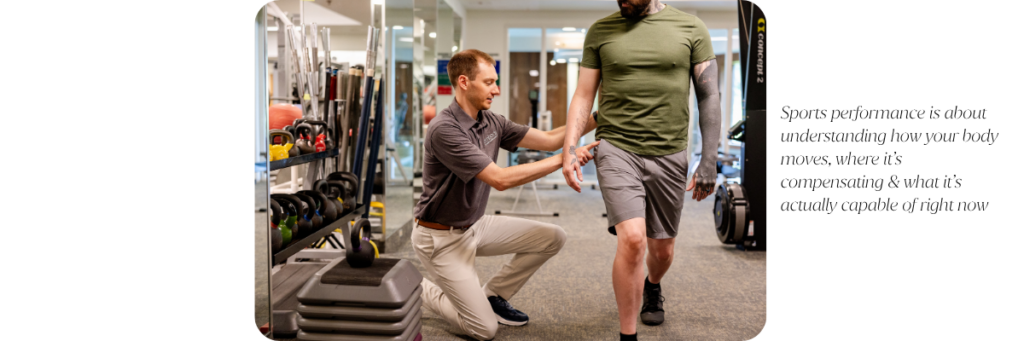
It’s about understanding:
- How your body moves
- Where it’s compensating
- What it’s actually capable of right now
Because here’s the truth:
Most performance limitations aren’t strength problems, they’re coordination problems.
Your body has the capacity.
But, it just doesn’t always have access to it.
What Four Things Actually Improves Performance (And Why It Works)
1. Movement Efficiency Changes Everything
When movement becomes more efficient, performance improves almost automatically.
You don’t just “move better”—you:
- Use less energy
- Generate more force
- Reduce unnecessary strain
- Recover faster
This is a core principle of physical therapy and performance.
Often, the changes aren’t dramatic.
They’re subtle:
- A shift in how you load your hip
- Better foot interaction with the ground
- Improved control through a range you already have
Small changes lead to meaningful results.
2. Strength That Holds Up Under Pressure
Many people are strong in controlled settings.
But performance doesn’t happen in perfect conditions.
It happens:
- Under fatigue
- Under speed
- Under variability
That’s where things often break down.
Physical therapy and performance training focus on building:
- Strength that adapts
- Control that holds under stress
- Coordination across the whole system
Because strength without control eventually finds its limit.
3. Mobility You Can Actually Use
Mobility is often misunderstood.
It’s not just about stretching more.
It’s about:
- Accessing range
- Controlling that range
- Using it under load
If your body doesn’t trust a position, it won’t use it.
Instead, it will compensate.
That’s where inefficiency builds—and where injury risk increases.
Physical therapy helps restore not just motion, but usable motion.
4. Load Management: The Missing Link in Performance
This is one of the most overlooked parts of physical therapy and performance.
Most injuries don’t come from one bad workout.
They come from:
- Doing too much, too quickly
- Ignoring recovery signals
- Stacking stress without awareness
The body adapts, until it can’t.
Learning how to:
- Progress appropriately
- Adjust based on feedback
- Respect your current capacity
…is what allows you to train consistently.
And consistency always beats intensity.
Why Injuries Rarely Come Out of Nowhere
Injuries may feel sudden; however, they rarely are.
They’re usually the result of patterns building over time.
The body gives signals:
- Tightness that keeps returning
- A side that feels less stable
- Movements that feel slightly off
These aren’t random.
They’re early warnings.
And when ignored, they don’t disappear.
They escalate.
Performance Across a Lifetime
Physical therapy and performance aren’t just for athletes.
They apply to anyone who wants to keep doing what they care about.
Because performance evolves.
For some, it’s about speed and power.
For others, it’s about:
- Staying active without pain
- Keeping up with daily life
- Maintaining independence
Different goals.
Same foundation:
A body that moves well, adapts well, and recovers well.
What that actually looks like changes depending on where you are in life.
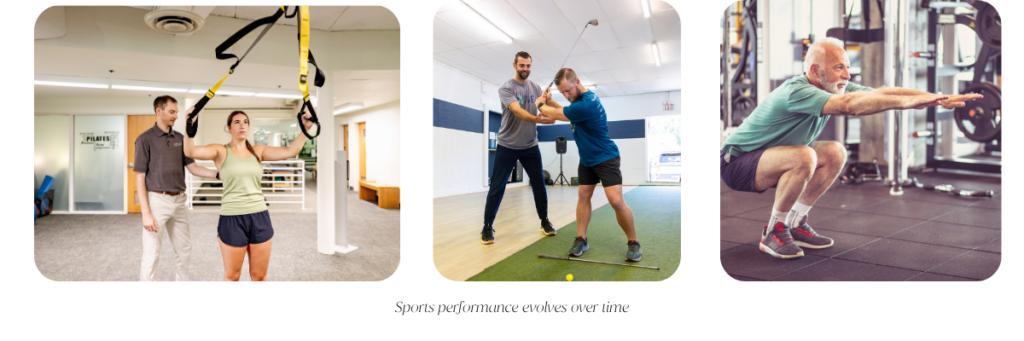
Performance Isn’t Just for One Stage of Life
When we talk about physical therapy and performance, it’s easy to picture athletes.
But performance isn’t limited to sport—or to a certain age.
In reality, performance evolves over time.
Youth and Adolescents
For young athletes, physical therapy helps develop proper movement patterns early.
As a result, it reduces injury risk during growth spurts and intense training periods while building a foundation for long-term athletic development.
Adults and Active Individuals
For adults balancing workouts, careers, and family life, time and energy are often limited.
Because of this, physical therapy helps optimize how the body moves so training is more effective and sustainable.
Whether the goal is improved fitness, recreational sports, or staying pain-free, the body still needs to handle the demands placed on it.
Older Adults
As we age, strength, balance, and mobility naturally decline—however, they don’t have to disappear.
Physical therapy helps maintain independence, reduce fall risk, and support an active lifestyle,
so that, over time, you can continue doing the things that matter most.
Where Most Approaches Fall Short
Most systems separate things that are actually connected.
You’ll often see:
- Rehab in one place
- Strength training in another
- Recovery somewhere else entirely
And when something feels off, you’re left trying to figure out where to go.
But the body doesn’t operate in categories.
At the same time, most systems continue to treat it that way.
And when care is fragmented, progress often is too.
So What Does This Look Like in Practice?
At some point, most people realize it’s not just about finding the right exercise or the right treatment.
It’s about having the right lens.
At Embody Health and Performance, we don’t separate:
We integrate them.
Because sometimes what shows up as a performance issue isn’t just a strength problem.
It might be:
- A joint that isn’t moving well
- A movement pattern that’s compensating
- A system that’s overloaded and not recovering
And those things don’t exist in isolation.
So instead of asking, “Which service do you need?”
we ask a better question: “What does your body need right now?”
From there, we build with intention.
Not just to make you stronger or more mobile,
but rather to help you become more capable and more efficient—
so that, over time, you can continue doing what matters most to you.
FAQs: Physical Therapy and Performance
Yes—in fact, this is often when it’s most effective. Physical therapy helps identify movement inefficiencies and limitations before they become injuries, so that, over time, you can improve performance proactively.
Because consistency alone isn’t enough, repeating inefficient movement patterns or mismanaging load will eventually lead to breakdown. Over time, therefore, those patterns place increasing stress on the body.
No, in reality, physical therapy and performance apply to anyone who wants to move better, train consistently, and avoid injury.
Physical therapy focuses on movement quality, mechanics, and injury prevention. Personal training often focuses on fitness goals. The best results come when both are aligned.
Trying to push through limitations instead of understanding them.


