Living with an autoimmune condition often means learning to manage symptoms that don’t follow a predictable pattern — joint discomfort one week, fatigue and muscle tension the next. Managing that well takes more than one tool. Many people build a toolkit of approaches that work together to keep them active, and red light therapy has earned a place in that toolkit for good reason.
Red light therapy (RLT) supports tissue health, reduces discomfort, and aids recovery at the cellular level. It isn’t a treatment for autoimmune disease itself, but paired with physical therapy and your prescribed medical care, it’s a genuinely useful piece of a whole-person plan.
What Is Red Light Therapy?
Red light therapy delivers specific wavelengths of red and near-infrared light to the body. Unlike ultraviolet light, these wavelengths don’t damage the skin — they’re absorbed by structures inside the cell, particularly the mitochondria, where they influence energy production, circulation, and tissue repair.
Those same cellular processes are deeply connected to inflammation and healing. That connection is exactly why photobiomodulation — the broader scientific term for red and near-infrared light therapy — has become a serious area of interest in immune research, not just recovery and skincare.
How Photobiomodulation Interacts With the Immune System
A 2025 review published in Lasers in Medical Science examined how photobiomodulation interacts with immune cells such as macrophages, T cells, and dendritic cells, and how it influences the cytokines that drive inflammation.
Here’s what that research points to: red and near-infrared light is absorbed by a component of the mitochondria involved in energy production, helping cells generate energy more efficiently and manage internal stress. That process is tied to real shifts in immune signaling — pro-inflammatory cytokines decreasing, anti-inflammatory signals increasing, and macrophages shifting from an inflammatory state toward one associated with repair. There’s also growing interest in photobiomodulation’s effect on regulatory T cells, the cells responsible for keeping the immune system from attacking the body’s own tissue. Improved local circulation supports the process further, delivering oxygen and nutrients to tissue that needs it.
This is where red light therapy earns its place alongside conventional autoimmune care: it works with the body’s own repair and regulation systems rather than against them.
Where Red Light Therapy Offers Real Support
Joint and Muscle Comfort
Recurring joint or muscle discomfort is one of the most common autoimmune symptoms, and it’s often the thing standing between you and staying active. Photobiomodulation supports comfort and mobility in musculoskeletal conditions, which matters because comfort is what makes it possible to actually show up for a physical therapy program.
Recovery and Tissue Health
Fatigue and inflammation make consistency hard, and inconsistency is what lets symptoms compound. Red light therapy supports cellular energy production and circulation, which supports your body’s normal recovery process after exercise or physical activity — exactly the kind of support that keeps a movement plan sustainable.
Inflammation-Related Symptoms
Inflammation sits at the center of nearly every autoimmune condition. Photobiomodulation’s effect on inflammatory signaling is one of the most studied applications of this therapy, and it’s a meaningful complement to your existing medical treatment plan — not a competitor to it.
More Comfortable Movement
Physical therapy focuses on strength, mobility, balance, and function — the things that let you keep doing what matters to you. When pain or stiffness gets in the way, red light therapy helps clear a path back to that. The goal isn’t just less symptom, it’s more life: more movement, more participation, more of what you actually want to be doing.
Autoimmune Conditions People Ask About
Rheumatoid Arthritis
Joint inflammation and stiffness define rheumatoid arthritis, and joint comfort and mobility are where photobiomodulation research has focused most. Many people use red light therapy alongside their rheumatologist-directed treatment to support daily comfort.
Hashimoto’s Thyroiditis
Photobiomodulation is an emerging area of support for autoimmune thyroiditis. It works alongside your endocrinologist and existing thyroid treatment — not in place of it.
Lupus
Lupus affects the joints, skin, and other systems, so no two experiences look the same. Interest in red light therapy here centers on inflammation and skin-related symptoms, and it fits best as one piece of a broader, individualized plan.
Psoriasis and Psoriatic Arthritis
Red light therapy reaches both the skin and the tissue beneath it, which makes it a natural fit for psoriatic arthritis and psoriasis alike — supporting joint symptoms and skin symptoms together, alongside your dermatologic or rheumatologic care.
Why This Matters
An autoimmune condition can quietly narrow your world — fewer walks, skipped workouts, activities put off “until I feel better.” Red light therapy matters because it lowers the barrier to movement, and movement is what actually changes how you feel over time. Supporting the body at the cellular level and supporting it through purposeful, well-guided activity aren’t separate strategies. They’re the same strategy, working from two directions at once.
How Embody Approaches This
At Embody, red light therapy works best as part of a broader plan. For clients managing autoimmune conditions, we typically encourage pairing sessions with physical therapy focused on adaptive, awareness-driven strength: movement that respects flare-ups and fatigue on a given day while still building capacity over time. That said, red light therapy is also available on its own for clients who want to start there or who are simply looking for that piece of support. Our integrative physical therapy team in Minnetonka can help you figure out whether red light therapy alone, physical therapy, or a combination of both is the right starting point for you.
What a Session Looks Like at Embody
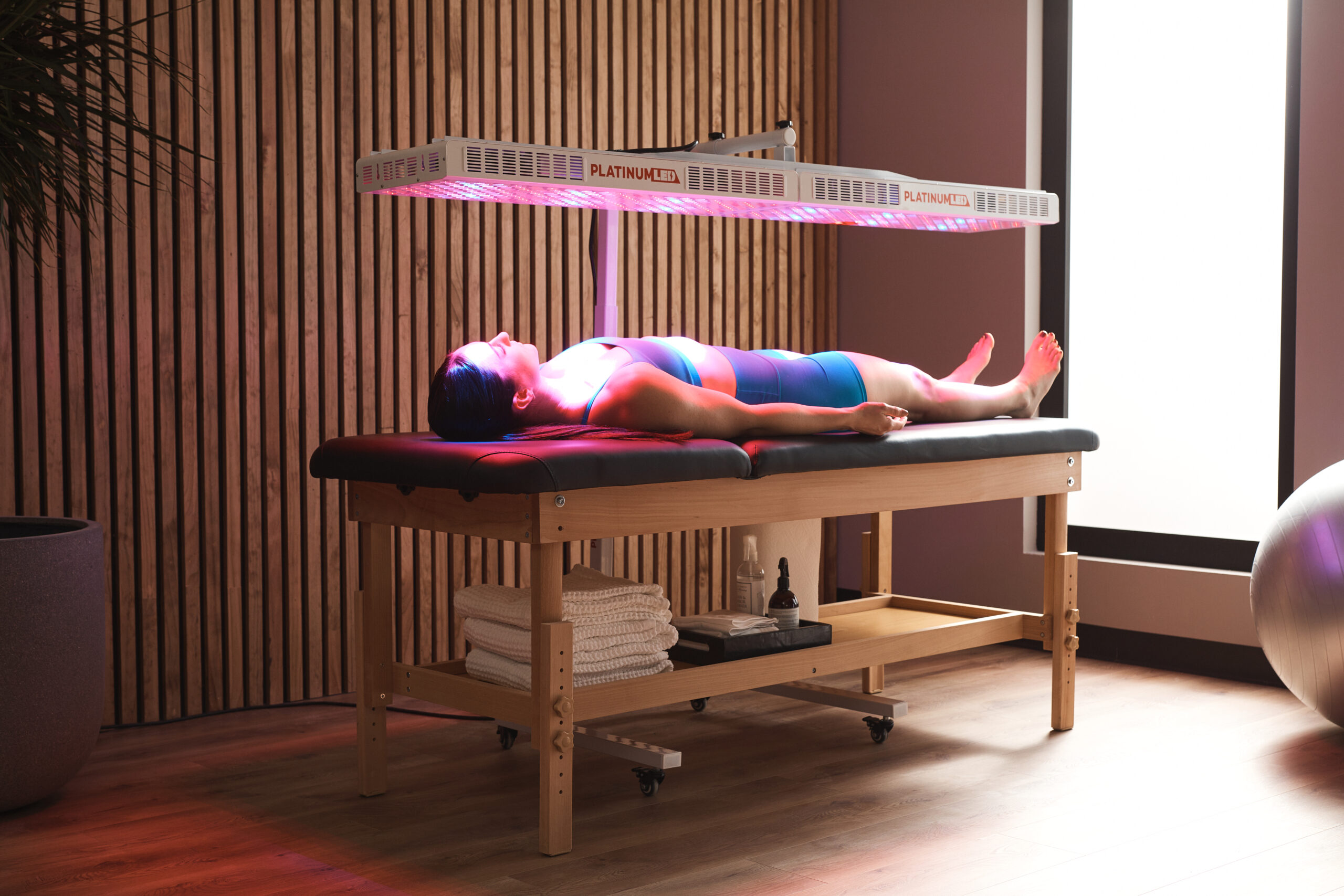
Red light therapy sessions at Embody use a medical-grade, full-body panel delivering red and near-infrared wavelengths, primarily in the 660 nm and 850 nm range with additional wavelengths up to 1060 nm for deeper tissue penetration. You’ll lie comfortably in a private space for about 20 minutes while your entire body is bathed in light, rather than treating one small area at a time. There’s no downtime afterward, so it fits easily into a lunch break or before or after a physical therapy visit.
When to Reach Out
Red light therapy and physical therapy are valuable tools, and some symptoms need medical attention first. Contact your physician promptly if you experience sudden or severe joint swelling, new numbness or weakness, unexplained fever, chest pain, or any symptom that feels significantly different from your usual pattern.
If you’re living with an autoimmune condition and pain, stiffness, or fatigue is affecting your ability to move and enjoy daily life, we’re happy to talk through whether red light therapy, physical therapy, or both are the right fit for you. Call us at 952.935.4037, Monday through Friday from 7:00 AM to 5:00 PM, or visit our Contact page to request a call or ask a question.
This article is educational and is not a substitute for individualized medical care. Please consult your physician regarding your specific autoimmune condition and treatment plan.


